The Thar Desert, renowned for its harsh and extreme climate, is facing an ironic twist as it struggles to sustain itself due to the changing environmental conditions and desertification.
It has been traditionally known as an unforgiving environment where adaptation is difficult. However, in today's reality, the desert itself is fighting to survive against the challenges imposed by the shifting climate.
Amidst the challenges posed by climate change, its effects on land, life and living of the Thar desert have become increasingly apparent, with increasing temperature, heatwaves and in the previous month with floods emerging as a significant concern.
It is ironic how we once sought water deep under the dunes, and now floods have emerged, linked to climate change. Rajasthan's rainfall pattern has shifted, with more 'heavy rain' days causing recurrent floods, even in desert areas like Bikaner. From 1989 to 2018, rainfall data reveals a notable increase in 'heavy rain' days, mainly in the western region. Bajju village and the nearby village faced floods, causing a halt in transportation, impacting farming, and disrupting the daily lives of people, prompting us to consider the urgent need for climate action.
The current year has witnessed numerous alerts across different districts of Rajasthan, signalling the occurrence of rainfall, thunderstorms, hailstones, heatwaves, and strong winds. These natural phenomena pose significant challenges for the local population, directly impacting their way of life. While the desert has historically relied on limited rainfall, these gradual changes in the climate are now adversely affecting its delicate ecology.
It is of growing significance to confront these challenges head-on, acknowledge their existence, and proactively initiate efforts aimed at mitigating the impacts of climate change. Just as deserts naturally possess resilience, there arises a pressing requirement to cultivate resilience anew, taking deliberate measures that strive to restore ecological equilibrium to the vulnerable Thar Desert
Urmul Seemant Samiti, Bajju has been working with adolescent girls on menstrual hygiene management and sanitary napkin preparation, usage and disposal. With support from Plan International, the team has conducted several training and awareness programs for leaders of adolescent girl groups from different villages of the project area. Through these training and awareness programs, the girls were constantly oriented on menstrual hygiene management and developed their understanding on menstrual cycle and how they can make sanitary napkins at home with localized material.
They in turn shared the awareness to their peers and group members and on how to avail benefit of free distribution of napkins through government. Previously adult female members of their family were using cloths or sand filled Terry Cotton cloths during menstrual period but after orientation by group members, they started using sanitary napkins. But due to poverty and the high cost of sanitary napkins all adult females were not getting sanitary napkins easily. As a step forward, for behavioral change of adult female members of their families and easy availability of sanitary napkin, Saraswati Vandna Kishori Prerna Manch (An Adolescent Girl Group) of Shambhu Ka Burj village demanded for setting up a sanitary napkin making unit at village. This unit was set up under the programme in 2019 where today girls are making sanitary napkins for personal usage as well as for sale. The girls were honored and encouraged for their efforts by the Zila Parishad on Republic day.
Effective communication is important for any organisation, essential for its smooth functioning. In today's era of information overload, relying on communication becomes increasingly challenging and erodes trust in the veracity of the information we receive.
The stakes of credibility are particularly high for civil society organisations, which once relied solely on the power of word-of-mouth. While this approach was potent within a limited circle, it couldn't fully capture the depth of their endeavours. These organisations are more than accomplishments shared one day; they embody tales of struggle and the human experience, intricately woven into the fabric of society.Their stories transcend tangible outcomes. They delve into the profound journey of building friendships, fostering trust, and forging partnerships. These narratives encompass the initial conversations that birthed trust, the apprehension of the unknown, and the meticulous documentation of their processes, tireless work, and the hidden wellspring of mutual motivation.
Embracing this spirit of growth and enlightenment, we have embarked on a transformative path.
Effective Communication and Storytelling Workshop
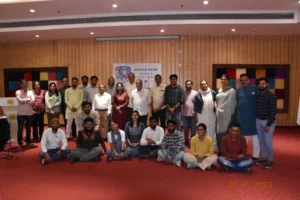
Two members took part in a workshop organised by Vikas Samvad in Bhopal, held from May 23rd to May 27th. This gathering emphasised the paramount significance of storytelling and effective communication. Journalists and civil society organisations hailing from Chhattisgarh, Madhya Pradesh, and Rajasthan Participated, practising and learning effective communication with exchange of personal experiences amongst the twenty participants.
Writeshop- embracing a change
Urmul Seemant Samiti, in collaboration with the Rajasthan Natural Farming Coalition, hosted a two-day writeshop on June 14th and 15th. The primary objective was to impart invaluable skills for capturing and documenting the inspiring ground-level stories of farmers transitioning towards or embracing natural farming practices. The event brought together nine remarkable organisations, including Disha-RDCSS, Desert Resource Centre, FES, GRAVIS, JKBT, Seva Mandir, and Unnati, creating an atmosphere brimming with innovation and collective wisdom.
Bahula Hatai- Interactive youtube programme for farmers
Embed Video Link : बहुला हथाई डॉ राजेश कुमार सावल रे साथै
A program dedicated to supporting farmers in western Rajasthan. It provides valuable assistance and knowledge sharing opportunities to address the specific needs and challenges faced by farmers.
To ensure accessibility, Bahula Hathai content will be available on YouTube. Farmers can access a wide range of informative videos.These videos can be watched at any time, allowing farmers to learn at their own pace and fit the program into their schedules.
Bahula Hathai will bring together a diverse range of experts, including agricultural scientists, agronomists and experienced farmers.


 The current year has witnessed numerous alerts across different districts of Rajasthan, signalling the occurrence of rainfall, thunderstorms, hailstones, heatwaves, and strong winds. These natural phenomena pose significant challenges for the local population, directly impacting their way of life. While the desert has historically relied on limited rainfall, these gradual changes in the climate are now adversely affecting its delicate ecology.
It is of growing significance to confront these challenges head-on, acknowledge their existence, and proactively initiate efforts aimed at mitigating the impacts of climate change. Just as deserts naturally possess resilience, there arises a pressing requirement to cultivate resilience anew, taking deliberate measures that strive to restore ecological equilibrium to the vulnerable Thar Desert
The current year has witnessed numerous alerts across different districts of Rajasthan, signalling the occurrence of rainfall, thunderstorms, hailstones, heatwaves, and strong winds. These natural phenomena pose significant challenges for the local population, directly impacting their way of life. While the desert has historically relied on limited rainfall, these gradual changes in the climate are now adversely affecting its delicate ecology.
It is of growing significance to confront these challenges head-on, acknowledge their existence, and proactively initiate efforts aimed at mitigating the impacts of climate change. Just as deserts naturally possess resilience, there arises a pressing requirement to cultivate resilience anew, taking deliberate measures that strive to restore ecological equilibrium to the vulnerable Thar Desert


 of information overload, relying on communication becomes increasingly challenging and erodes trust in the veracity of the information we receive.
The stakes of credibility are particularly high for civil society organisations, which once relied solely on the power of word-of-mouth. While this approach was potent within a limited circle, it couldn't fully capture the depth of their endeavours. These organisations are more than accomplishments shared one day; they embody tales of struggle and the human experience, intricately woven into the fabric of society.Their stories transcend tangible outcomes. They delve into the profound journey of building friendships, fostering trust, and forging partnerships. These narratives encompass the initial conversations that birthed trust, the apprehension of the unknown, and the meticulous documentation of their processes, tireless work, and the hidden wellspring of mutual motivation.
Embracing this spirit of growth and enlightenment, we have embarked on a transformative path.
Effective Communication and Storytelling Workshop
Two members took part in a workshop organised by Vikas Samvad in Bhopal, held from May 23rd to May 27th. This gathering emphasised the paramount significance of storytelling and effective communication. Journalists and civil society organisations hailing from Chhattisgarh, Madhya Pradesh, and Rajasthan Participated, practising and learning effective communication with exchange of personal experiences amongst the twenty participants.
of information overload, relying on communication becomes increasingly challenging and erodes trust in the veracity of the information we receive.
The stakes of credibility are particularly high for civil society organisations, which once relied solely on the power of word-of-mouth. While this approach was potent within a limited circle, it couldn't fully capture the depth of their endeavours. These organisations are more than accomplishments shared one day; they embody tales of struggle and the human experience, intricately woven into the fabric of society.Their stories transcend tangible outcomes. They delve into the profound journey of building friendships, fostering trust, and forging partnerships. These narratives encompass the initial conversations that birthed trust, the apprehension of the unknown, and the meticulous documentation of their processes, tireless work, and the hidden wellspring of mutual motivation.
Embracing this spirit of growth and enlightenment, we have embarked on a transformative path.
Effective Communication and Storytelling Workshop
Two members took part in a workshop organised by Vikas Samvad in Bhopal, held from May 23rd to May 27th. This gathering emphasised the paramount significance of storytelling and effective communication. Journalists and civil society organisations hailing from Chhattisgarh, Madhya Pradesh, and Rajasthan Participated, practising and learning effective communication with exchange of personal experiences amongst the twenty participants.